

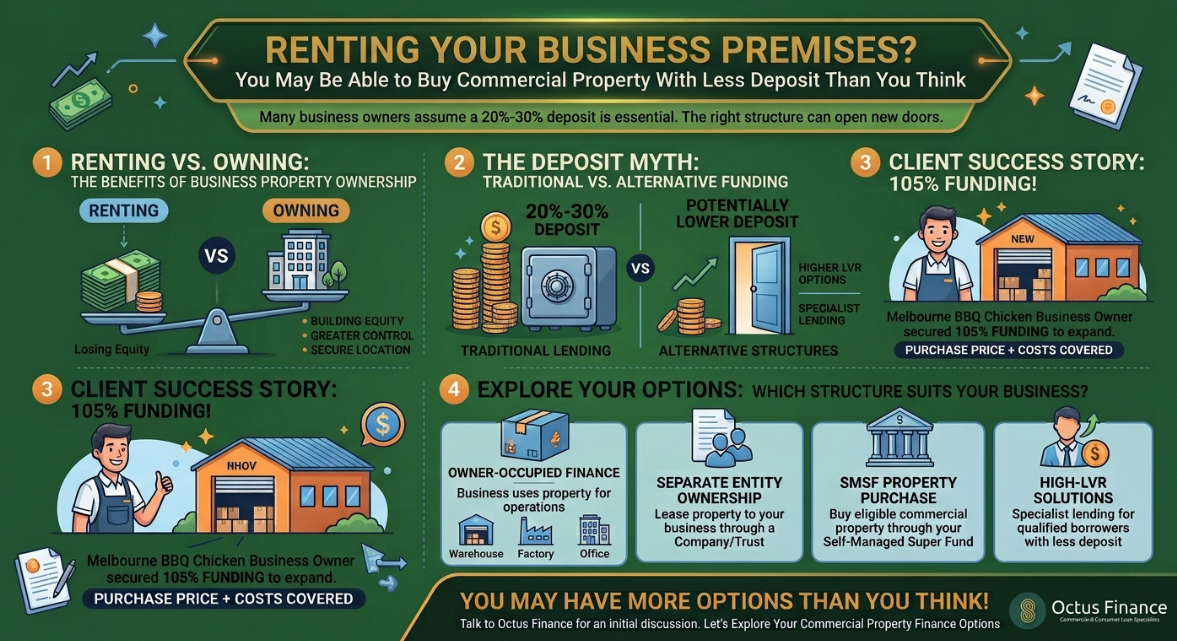
Renting Your Business Premises? You May Be Able to Buy Commercial Property With Less Deposit Than You Think
Many Australian business owners assume they need a substantial cash deposit to buy commercial property. But depending on their circumstances, the property and the right lending structure, there may be ways to purchase business premises with significantly less cash upfront than they expect.
If you’re renting an office, warehouse, workshop, factory or retail shop, have you considered purchasing a commercial property for your business instead?
For many business owners, the biggest obstacle isn’t finding a suitable property. It’s the belief that buying one requires a 20%–30% deposit, plus additional funds to cover stamp duty, legal fees and other purchase costs.
While traditional commercial property lending often requires a significant deposit, some specialist lending arrangements can offer higher levels of funding. In certain circumstances, a suitable transaction may even be structured to cover the entire purchase price and associated costs.
At Octus Finance, we understand that commercial property finance isn’t always a one-size-fits-all exercise. The right structure can make a significant difference to what’s possible.
Let’s explore the options available to business owners, including a genuine client success story involving 105% funding.
1. Why Keep Renting When You Could Own Your Business Premises?
If your business has been operating from rented premises for several years, you already know how much space you need, whether the location works for your customers and how well the property supports your operations.
But while you pay rent every month, the property remains an asset owned by someone else.
Purchasing suitable commercial premises could allow your business to become the property owner, build equity over time and potentially gain greater control over its operating location.
Depending on your circumstances, owning your premises may also offer benefits such as:
- Greater certainty over where your business operates, subject to the loan and ownership arrangements.
- The opportunity to build equity as the loan is repaid.
- Greater control over future property improvements, subject to relevant approvals.
- Potential long-term property ownership alongside your operating business.
However, ownership also brings additional responsibilities, including loan repayments, maintenance, insurance, rates and other property expenses. Buying isn’t necessarily the right choice for every business.
The key is to assess whether purchasing makes commercial and financial sense for your business.
2. Do You Really Need a 20%–30% Deposit?
A traditional commercial property loan may fund around 70%–80% of a property’s accepted value, depending on the property type, lender and transaction.
For example, if you’re purchasing a commercial property for $1 million and a lender offers 75% LVR, you would generally need to contribute $250,000 towards the purchase price, as well as cover acquisition costs.
For many business owners, finding that amount of cash can be difficult, even when their business is profitable and has a strong trading history.
However, some lenders offer alternative commercial property finance structures that may allow substantially higher funding in suitable circumstances.
Depending on the lender and the overall transaction, funding may potentially cover:
- A substantial proportion of the purchase price.
- The full purchase price.
- In certain specialised arrangements, the purchase price plus eligible acquisition costs.
The availability of these options depends on the lender’s criteria, the business’s financial position, the property, repayment capacity and any additional security requirements.
The important point is that a large cash deposit isn’t necessarily the only way to approach a commercial property purchase.
Before assuming you cannot afford to buy, it may be worth having your circumstances assessed by a commercial finance broker.
3. A Real Client Success Story: 105% Funding for a Melbourne BBQ Chicken Business
One example from our own experience involved David, a BBQ chicken shop owner in Melbourne.
The opportunity
A commercial property next door to David’s existing shop came onto the market.
It was an ideal opportunity to expand his business, and he was keen to secure the property before it went to auction.
There was just one major obstacle: the deposit.
David believed he would need to contribute 20%–30% of the purchase price from his own savings, on top of the money required to cover the associated purchase costs.
Although he was keen to expand, he had limited cash savings available and initially thought the purchase simply wasn’t possible.
The solution
Rather than treating the transaction as a conventional commercial property purchase requiring a large cash deposit, we reviewed David’s overall financial position and explored an alternative lending structure.
We were able to structure the transaction and present it to a major bank in a way that allowed the borrowing to cover 105% of the purchase price, including fees and charges.
This was a transaction-specific outcome based on David’s circumstances and the lending structure, rather than a standard funding option available to every commercial property buyer.
The result
David successfully purchased the neighbouring property before it went to auction, without needing to contribute a large cash deposit from his savings.
He was able to expand his BBQ chicken business into the additional premises and secure an opportunity that he initially believed was beyond his financial reach.
What can other business owners learn from David’s experience?
David’s story demonstrates why it can be worthwhile to explore different lending structures before ruling out a commercial property purchase.
Every transaction is different, and not every borrower will qualify for this level of funding. However, a lack of a traditional deposit doesn’t automatically mean that buying commercial property is impossible.
The right starting point is to assess your business, the property and the available lending options.
4. Buying Your Own Business Premises: Owner-Occupied Commercial Finance
When a business purchases a property that it will use for its own operations, this is generally referred to as an owner-occupied commercial property purchase.
For example, the property could be:
- A warehouse for a distribution or manufacturing business.
- A factory or workshop for a trade business.
- A retail shop for an established retailer.
- An office for a professional services business.
- A hospitality premises for a restaurant, café or takeaway business.
Depending on the lender, the property’s intended use and the transaction structure, owner-occupied commercial finance may be assessed differently from a commercial investment property loan.
Lenders may consider the business’s trading history, financial performance, existing commitments, repayment capacity and the suitability of the property.
Some specialised lenders may also consider higher-LVR structures where the application meets their requirements.
This is why it can be valuable to explore options across different lenders rather than assume that every commercial loan requires the same deposit.
5. What If You Want to Buy a Commercial Property and Lease It to Your Business?
Another option is to purchase a commercial property through an appropriate ownership entity and lease it to your operating business.
For example, a separate company or trust might own a warehouse, while your trading business leases the premises under a formal lease agreement.
This can separate ownership of the property from the day-to-day operations of the business.
However, the appropriate structure depends on your circumstances, including asset protection considerations, tax implications, borrowing capacity and your long-term plans.
You should obtain appropriate legal and taxation advice before deciding how the property should be owned.
6. Could You Purchase Your Business Premises Through an SMSF?
For some business owners, another option worth exploring is purchasing eligible commercial property through a self-managed super fund (SMSF).
Under the appropriate circumstances, an SMSF can acquire business real property and lease it to a related business, including a business operated by the fund’s members.
For example, an SMSF could purchase a warehouse that is then leased to the member’s manufacturing business under a genuine commercial lease.
The business pays rent to the SMSF, and the fund receives the rental income. The fund may use that income towards property expenses and loan repayments, subject to its obligations and circumstances.
This arrangement can allow a business owner to operate from the premises while the property is held within their superannuation fund.
How does SMSF commercial property finance work?
SMSF property borrowing generally involves a limited recourse borrowing arrangement (LRBA), with the property held through a separate holding trust.
Unlike some specialised owner-occupied commercial lending arrangements, SMSF commercial property loans generally require the fund to contribute a deposit and cover acquisition costs.
The available LVR depends on the lender, property, fund and transaction. The SMSF must also retain sufficient liquidity to meet its ongoing obligations.
Important considerations before using an SMSF
An SMSF property purchase is not simply a way to avoid a deposit or transfer a business property into superannuation without restrictions.
The arrangement must comply with applicable superannuation laws, including the rules relating to business real property, arm’s-length dealings and the sole-purpose test.
The lease must generally be on commercial terms, with rent set at market value. The SMSF must also be able to meet its investment strategy and other obligations.
An SMSF is not suitable for every business owner, and establishing one solely to buy a commercial property may not be appropriate.
Before proceeding, seek advice from a suitably licensed financial adviser, accountant and solicitor with relevant SMSF experience.
For further information, see the Australian Government’s Moneysmart guide to SMSFs and property.
7. Which Commercial Property Finance Option Could Suit You?
The most suitable option will depend on whether you’re buying premises for your own business, purchasing a property to lease to your business or considering an SMSF structure.
| Option | What to consider |
| Owner-occupied commercial property loan | Your business’s financial position, property suitability, borrowing capacity and available security. |
| Specialist high-LVR commercial finance | Whether a lender can consider funding above conventional LVR limits and what additional security or conditions may apply. |
| Property owned by a separate entity and leased to your business | The ownership structure, commercial lease, tax implications and lender requirements. |
| SMSF commercial property purchase | Superannuation rules, fund liquidity, deposit requirements, borrowing structure and professional advice. |
These options are not interchangeable, and some structures may be unsuitable for particular transactions.
The goal is to identify an arrangement that meets the lender’s requirements and is sustainable for your business over the longer term.
8. Don’t Assume You Need a Large Deposit Before Exploring Your Options
If you’re currently renting your business premises, or an opportunity has come up to purchase a neighbouring commercial property, it may be worth reviewing your finance options before ruling out the purchase.
As David’s experience demonstrates, the right lending structure can sometimes make a transaction possible even when the borrower doesn’t have a traditional cash deposit available.
At Octus Finance, we help Australian business owners explore commercial property finance options through a panel of bank and non-bank lenders.
Whether you’re looking to buy your existing premises, expand into a neighbouring property, purchase a warehouse or explore an eligible SMSF property strategy, we can help you understand the potential options based on your circumstances.
You may have more options than you think.
Let’s Explore Your Commercial Property Finance Options
If you’re a business owner currently paying rent and wondering whether buying commercial property could be achievable, contact Octus Finance for an initial discussion.
We can review your circumstances and help identify potential lending options, including whether a higher-LVR funding structure may be available for your transaction.
General information only. This article does not constitute financial, taxation, legal or personal credit advice. Commercial lending is subject to lender criteria, valuation, serviceability, security requirements and approval. High-LVR and 100% or greater funding arrangements are specialised and are not available in all circumstances. Additional security and other conditions may apply. SMSF strategies involve complex legal, taxation and financial considerations; obtain appropriate professional advice before proceeding.