

For many Australian business owners, the focus is understandably on running the business — managing staff, customers, suppliers, cash flow and growth.
But there is another cost that can quietly eat into profitability: the interest rate on your existing business debt.
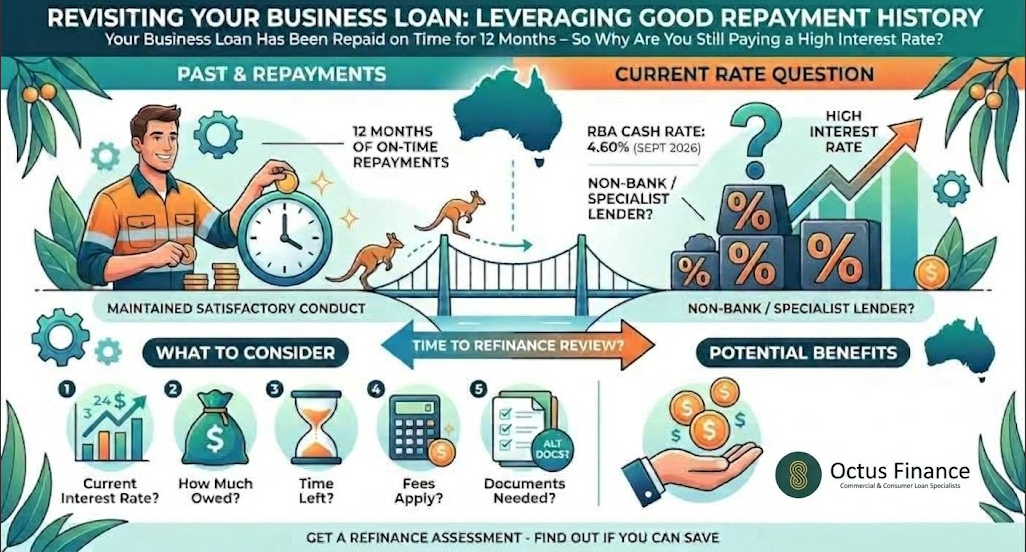
With the Reserve Bank of Australia increasing the cash rate to 4.60% in September 2026, borrowing costs have become an even more important consideration for businesses. The RBA has also noted that financial conditions have tightened and that higher interest rates are flowing through to business lending rates.
If you have an existing business loan, particularly one originally obtained through a non-bank or specialist lender, it may be worth asking a simple question:
Does the reason I originally took this loan still justify the interest rate I am paying today?
Your circumstances may have changed
A business loan that made sense two or three years ago may not necessarily be the most competitive or appropriate facility today.
Perhaps the loan was originally arranged when:
- The business had a shorter trading history
- Traditional banks were unwilling to lend
- Financial statements were not yet available
- The business needed funding quickly
- The borrower had a complex structure
- The loan was required for a time-sensitive opportunity
- The business was going through a period of transition
At the time, obtaining the funding may have been the priority. That does not necessarily mean the same loan should remain in place indefinitely.
Your repayment history can tell an important story
One of the first things worth reviewing is your existing loan’s repayment history.
If you have maintained your repayments consistently and the facility has been conducted satisfactorily, your current position may be quite different from when the original loan was approved.
This can be particularly relevant for businesses that initially needed specialist or non-bank funding.
Depending on the lender, loan size, security, business circumstances and credit policy, there may be refinance options that place greater emphasis on the existing loan’s conduct and repayment history, rather than requiring a complete financial reassessment from scratch.
That does not mean every borrower will qualify, and lender requirements vary. But it is a conversation worth having.
Why refinancing can matter more when rates are higher
Consider a business with a $750,000 loan.
A reduction in the interest rate of just 2 percentage points would represent approximately $15,000 per year in interest savings, before considering the loan structure, fees, repayment method and other factors.
On a $1 million loan, the same 2 percentage-point difference represents approximately $20,000 per year.
The actual benefit will depend on the loan balance, repayment structure, remaining term, fees and the rate available.
The important point is that small differences in interest rates can become significant when applied to large commercial debts.
Refinancing isn’t always about finding the lowest rate
This is where business owners need to look beyond the headline interest rate.
Before refinancing, it is important to consider:
1. What is your current interest rate?
Start with the obvious question.
What are you actually paying today?
Do not rely on what you remember when the loan was originally arranged. Check your current loan statement or facility documents.
2. How much do you still owe?
The potential benefit of refinancing is linked to the remaining loan balance.
A rate reduction that looks attractive on paper may have a much smaller dollar impact if the outstanding balance is relatively low.
3. How long is left on the loan?
The remaining term matters.
Extending the term may reduce the immediate repayment burden but could increase the total interest paid over the life of the loan.
4. What fees will apply?
A refinance may involve application, valuation, legal, settlement or discharge costs depending on the facility and lender.
The right comparison is not simply:
Old interest rate vs new interest rate.
It is: Total cost of the existing facility vs total cost of the proposed facility.
5. Will the new lender require full financial documentation?
This can be particularly important for established business borrowers.
Some refinance solutions may use alternative approaches to assessing the application, depending on the lender and circumstances.
For eligible borrowers, this can sometimes make the refinance process considerably simpler.
However, simplified documentation does not mean automatic approval. The lender still needs to assess the application against its own credit policy.
Don’t wait until the loan becomes a problem
One of the biggest mistakes a business owner can make is waiting until cash flow becomes tight before reviewing their debt.
The RBA’s October 2026 Financial Stability Review noted that Australian businesses have generally remained resilient, while also highlighting the increased financial pressure arising from higher inflation and interest rates. It also noted continued competition among bank and non-bank lenders.
That means a business with a clean repayment history may have more options than an owner who waits until repayments become difficult.
The best time to review your business debt is generally before it becomes a problem.
A refinance review doesn’t necessarily mean you should refinance
This is an important distinction.
A good refinance assessment should not begin with:
“Let’s move your loan.”
It should begin with:
“Let’s see whether moving your loan actually makes sense.”
Sometimes the existing facility is still appropriate.
Sometimes the savings are too small to justify the costs.
Sometimes the current lender remains the best fit.
And sometimes a business has a genuine opportunity to materially reduce its borrowing cost or improve the structure of its debt.
The only way to know is to review the numbers.
What should business owners do now?
If you have a business term loan that was originally arranged at a relatively high rate, particularly through a non-bank or specialist lender, consider reviewing:
- Your current interest rate
- Outstanding loan balance
- Remaining loan term
- Repayment history over the past 12 months
- Current security position
- Business trading position
- Existing financial commitments
- Potential refinance costs
- Whether alternative documentation may be available
You may discover that your business has moved into a very different lending position from when the original loan was approved.
The bottom line
Interest rates are only one part of the cost of borrowing.
But when a business carries a significant loan balance, even a modest improvement in the interest rate can have a meaningful impact on cash flow and profitability.
If your business loan has been conducted cleanly, it may be worth finding out whether your current loan is still competitive for your circumstances.
You don’t necessarily need a new loan.
You may simply need to review the old one.
Octus Finance assists Australian businesses with business loan refinancing, commercial finance and tailored lending solutions across a range of bank and non-bank lenders. Lending is subject to lender assessment, eligibility and approval. This article is general information only and does not constitute financial, legal or tax advice.