

Running a business often means making important financial decisions at the right time. You may need finance to purchase equipment, expand your business, acquire another business, purchase commercial property or simply improve your working capital.
Whatever the reason, finding the right business loan can be challenging. Banks and other lenders have different lending policies, documentation requirements and ways of assessing business income.
Understanding what lenders look for before you apply can help you prepare properly and avoid unnecessary delays.
At Octus Finance, we help Australian business owners explore business and commercial finance options and identify lending solutions that suit their individual circumstances.
What do lenders look for when assessing a business loan?
Every lender has its own credit policy, but there are several key areas that are commonly considered when assessing a business finance application.
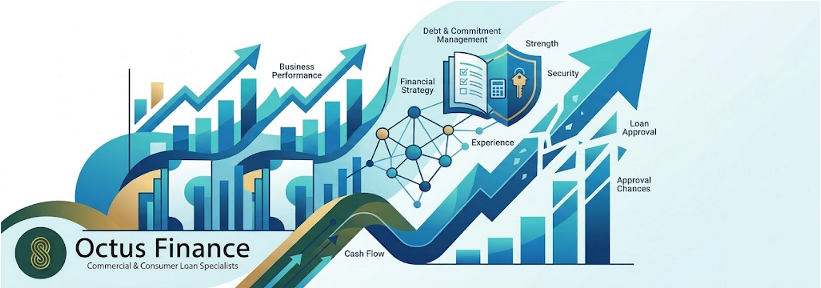
1. Your business financial performance
One of the first things a lender will want to understand is how your business has performed financially.
Depending on the type and size of the loan, the lender may ask for:
- Business tax returns
- Financial statements
- Profit and loss statements
- Balance sheets
- Business activity statements (BAS)
- Business bank statements
- Current management accounts
The lender will generally assess whether the business generates sufficient income to support the proposed loan repayments.
However, having a weaker financial year does not automatically mean your application will be unsuccessful. Different lenders have different approaches to assessing business income, particularly where there are reasonable circumstances behind a change in performance.
2. Your business cash flow
Profit is important, but lenders also want to understand how money moves through the business.
For example, a business may be profitable on paper but still experience cash-flow pressure because customers take time to pay invoices or because the business has significant operating expenses.
Lenders may review your business bank statements and financial information to understand:
- Regular business revenue
- Existing loan repayments
- Supplier payments
- Tax obligations
- Overdraft usage
- Cash reserves
- Overall account conduct
Consistent cash flow can help demonstrate that the business is capable of managing additional debt.
3. The purpose of the loan
The reason you are borrowing money can make a significant difference to the type of finance available to you.
Business finance may be used for purposes such as:
- Purchasing business equipment
- Buying commercial property
- Business acquisition
- Business expansion
- Working capital
- Refinancing existing business debt
- Purchasing vehicles or other business assets
- Property-backed business finance
Some lenders specialise in particular types of business finance, while others have more restrictive policies around certain purposes.
This is why comparing lenders based purely on interest rates isn’t always the best approach. The most suitable lender is one that understands your particular borrowing purpose and circumstances.
4. Your existing debts and financial commitments
Lenders will generally consider your existing financial commitments when assessing whether you can afford the proposed loan.
These may include:
- Existing business loans
- Equipment finance
- Credit cards
- Overdrafts
- Commercial property loans
- Residential mortgages
- Other personal or business liabilities
The lender wants to establish whether the business and, where relevant, the business owners can comfortably manage the existing commitments together with the new loan.
5. Your credit history
Your credit history may also form part of the lender’s assessment.
Depending on the lender, this can include reviewing:
- Existing credit facilities
- Repayment history
- Defaults
- Court judgments
- Recent credit enquiries
- Outstanding debts
Having an issue on your credit file doesn’t necessarily mean you cannot obtain business finance.
Different lenders have different credit policies, and some non-bank lenders may consider circumstances that a traditional bank may not.
The important thing is to understand your position before submitting an application and identify lenders whose credit policies are appropriate for your circumstances.
6. Available security and equity
Depending on the type and amount of finance you require, a lender may ask for security.
This could include:
- Residential property
- Commercial property
- The asset being purchased
- Other business assets
For example, a business owner who has substantial equity in a residential or investment property may have additional options when looking for business finance.
Property-backed business finance can sometimes provide a practical solution where traditional unsecured business lending isn’t suitable.
7. Your experience and the strength of the business
Your experience as a business owner can also be relevant to a lender’s assessment.
For an established business, the lender may focus heavily on its trading history and financial performance.
For a newer business or a business acquisition, other factors may become more important, including:
- Your industry experience
- Your experience running a business
- The business model
- Existing contracts or customers
- The financial performance of the business being purchased
- Available assets and security
- Your overall financial position
A strong business plan and a well-prepared application can help provide the lender with a clearer picture of the opportunity and the associated risks.
What if your business financials aren’t perfect?
This is a common concern among business owners.
Perhaps your business had a difficult year, you recently invested heavily in expansion, your income has increased significantly since your last financial year, or your financial statements don’t fully reflect the current position of the business.
That doesn’t necessarily mean finance is unavailable.
Different lenders have different ways of assessing business income and financial performance. Depending on the circumstances, some lenders may consider more recent management accounts, BAS information, bank statements or other evidence showing the current performance of the business.
The key is finding a lender whose lending policy fits your circumstances.
How can you improve your chances of getting approved?
Before applying for a business loan, it is worth getting your financial information organised.
Have your documents ready
Depending on the lender and the type of finance, you may need:
- Identification
- Business financial statements
- Tax returns
- BAS
- Business bank statements
- Asset and liability information
- Details of existing debts
- Information about the proposed purchase
- Property details if property is being offered as security
Having these documents available can help make the application process more efficient.
Be clear about how much you need
Before applying, work out exactly how much funding you require and what the money will be used for.
For example, if you are purchasing equipment, the lender may need details of the equipment and purchase price. If you are purchasing a business, the lender may require information about the business being acquired.
A clearly defined loan purpose makes it easier to structure the application appropriately.
Choose the right lender
One of the biggest mistakes business owners can make is assuming their existing bank is automatically the best lender for their next business loan.
Banks, non-bank lenders and specialist lenders can have very different policies.
One lender may have strict requirements around financial statements, while another may have a more flexible approach. One may be competitive for equipment finance but less suitable for commercial property, while another may specialise in property-backed business lending.
This is where comparing different lenders can add real value.
Why use a business finance broker?
Australia has a wide range of lenders offering different types of business finance. Understanding which lender is suitable for your particular circumstances can be difficult if you approach each lender individually.
A business finance broker can assess your circumstances, understand what you are trying to achieve and help identify potential lending options.
At Octus Finance, we work with business owners across Australia to help them explore suitable finance solutions for their businesses.
Whether you are looking for a business loan, commercial property finance, equipment finance, business acquisition finance or property-backed business finance, we can help you understand your options and structure your application appropriately.
Don’t assume your bank is your only option
If your bank has declined your application, asked for more security or offered terms that don’t work for your business, it doesn’t necessarily mean you have run out of options.
Different lenders assess applications differently.
The right solution may involve a traditional bank, a non-bank lender or a specialist commercial lender, depending on your circumstances and borrowing requirements.
Before submitting multiple applications, it can be worthwhile speaking with a finance broker to understand what options may be available.
Looking for a business loan in Australia?
Whether you’re looking to purchase equipment, expand your business, acquire another business, purchase commercial property, refinance existing business debt or access additional working capital, getting the right finance structure can make a significant difference.
At Octus Finance, we take the time to understand your business, your objectives and your financial position before exploring suitable lending options.
If you’re considering business finance, contact Octus Finance to discuss your requirements and explore your options.
Frequently Asked Questions
How much can I borrow for a business loan?
The amount you can borrow depends on several factors, including your business income, financial performance, existing debts, loan purpose, available security and the lender’s credit policy.
Can I get a business loan if my business is relatively new?
Potentially, yes. Some lenders may consider newer businesses depending on the owner’s experience, the purpose of the loan, available security and the overall strength of the application.
Can I use my home or investment property as security for a business loan?
Depending on the lender and loan structure, residential or investment property may be used as security for certain types of business finance.
Can I get business finance if my bank has declined my application?
Possibly. A decline from one lender does not necessarily mean finance is unavailable elsewhere. Different lenders have different credit policies and risk appetites.
Can a finance broker help me find a business loan?
Yes. A business finance broker can help you compare lending options and identify lenders that may be suitable based on your business circumstances, loan purpose and financial position.
How long does a business loan take to arrange?
The timeframe varies depending on the lender, loan type, complexity of the transaction and documentation required. Straightforward applications can sometimes be processed quickly, while more complex commercial transactions may take longer.
Ready to discuss your business finance options?
If you are considering a business loan or commercial finance, speak with Octus Finance today.
We can help you understand your options and identify potential finance solutions suited to your business.